Google Docs vs Microsoft Word & Office 365: 2026 Comparison
Google Docs vs Microsoft Word and Office 365 in 2026: which is cheaper, better for teams, stronger on AI, and how Word compatibility actually works.

Google Docs is the cloud-native, free-to-start word processor inside Google Workspace. Microsoft Word — bundled with Office 365 (now Microsoft 365) — is the desktop-first standard that most enterprises already use. The right choice depends on price, the kind of collaboration you need, and how much you rely on real Word formatting.
Google Docs and Microsoft Word both edit .docx files, but they handle compatibility differently — Google Docs converts files for cloud editing, while Word preserves formatting natively. This is the single biggest reason teams pick one over the other.
This guide compares Google Docs vs Microsoft Word and Office 365 across every category that matters in 2026: pricing, features, AI tools, mobile apps, email, file compatibility, and team collaboration. By the end you will know which is cheaper for your team size, better on AI, and stronger for shared editing.
Quick Comparison: Google Docs vs Office 365
Before diving into details, here's a side-by-side summary of how the two platforms stack up.
| Feature | Google Workspace | Microsoft 365 |
|---|---|---|
| Free tier storage | 15 GB | 5 GB |
| Paid plans start at | $7/user/month | $6/user/month |
| Desktop apps | No (browser only) | Yes (Word, Excel, PowerPoint) |
| Real-time collaboration | Built-in | Built-in |
| AI assistant | Gemini | Copilot |
| Video meetings | Google Meet (up to 500) | Teams (up to 1,000) |
| Gmail | Outlook | |
| Third-party integrations | 5,000+ apps | Growing marketplace |
| Offline editing | Via Chrome extension | Native desktop apps |
| File format support | Modern formats | Legacy and modern formats |
What Are Google Docs and Office 365?
Google Docs is a free, browser-based document editor. You can write solo or collaborate with others in real time. Every free Google account includes access to:
- Docs - word processing
- Sheets - spreadsheets
- Slides - presentations
- Gmail - email
- Google Drive - cloud storage (15 GB free)
- Keep - notes
For business features like custom email domains and admin controls, you need Google Workspace (paid plans start at $7/user/month).
Microsoft 365 is a productivity suite that includes both web and desktop apps. A free Microsoft account gives you access to:
- Word - word processing
- Excel - spreadsheets
- PowerPoint - presentations
- Outlook - email and calendar
- OneDrive - cloud storage (5 GB free)
- Teams - video meetings and chat
- OneNote - notes
Paid plans unlock full desktop apps, more storage, and advanced security features.
Both platforms run in the cloud and work on any device. The key difference: Google is browser-first, while Microsoft offers full desktop applications alongside its web versions.
Comparing Google Docs vs. Office 365
Here's how the two suites compare across the features that matter most.
Interface and Templates
Google Docs keeps things simple. When you sign in, you see your recent documents. You can sort them by title or last modified date. Creating a new document takes one click, and you can pick from about 50 templates.
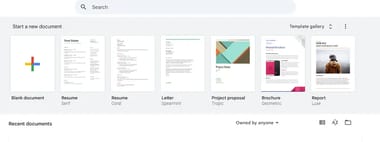
Google Docs templates
The editing interface is clean and minimal. A small menu sits at the top. A sidebar tracks your document sections. The toolbar shows the most common editing tools without clutter.
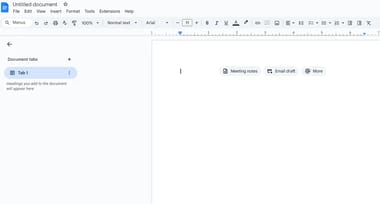
Google Docs document interface
Microsoft 365 has a richer interface. The home screen shows templates at the top, learning resources, and quick links to all apps in the left sidebar.
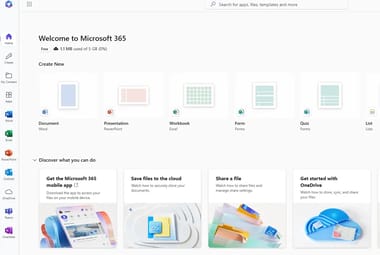
Microsoft 365 templates
The Word document dashboard offers more options than Google Docs but stays organized. A right sidebar lets you browse additional templates. Power users will appreciate the deeper toolbars and ribbon menus.
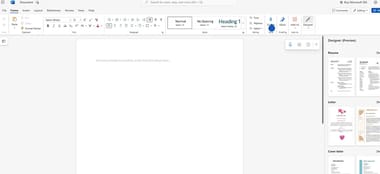
Microsoft 365 document interface with templates sidebar
Bottom line: Google Docs is easier to learn. Microsoft 365 gives you more control once you learn the interface.
Storage
Storage can be a deciding factor, especially for teams that handle many files.
- Google free tier: 15 GB shared across Docs, Gmail, Drive, and Photos
- Microsoft free tier: 5 GB on OneDrive
- Google Workspace paid: 30 GB to 5 TB per user, depending on the plan
- Microsoft 365 paid: 1 TB per user on most plans (Family plan offers up to 6 TB shared)
Google gives you three times more free storage. But Microsoft's paid plans jump straight to 1 TB, which is generous for the price.
Collaboration
Both platforms are built for teamwork. Google Docs and Microsoft Word both support:
- Real-time co-editing with multiple users
- Change tracking and version history
- Comments and suggestions
- Built-in chat while editing
Google Docs was built for collaboration from day one. It works smoothly. Microsoft 365 has caught up in its web apps. But collaboration in desktop Word can feel slower than the web version.
For video meetings:
- Google Meet allows up to 500 regular participants, plus 500 view-only
- Microsoft Teams supports up to 1,000 regular participants and 9,000 view-only (10,000 total)
If large meetings are part of your workflow, Teams has a clear advantage.
AI Features: Copilot vs Gemini
Both platforms now include AI assistants that can draft, edit, and summarize content.
Microsoft Copilot is built into Word, Excel, PowerPoint, Outlook, and Teams. It can:
- Draft documents from prompts
- Summarize long emails and meeting transcripts
- Create presentations from text descriptions
- Analyze data and build charts in Excel
- Copilot Pro costs $20/month per user on top of your Microsoft 365 subscription
Google Gemini is integrated into Docs, Sheets, Slides, and Gmail. It can:
- Write and rewrite text in Docs
- Generate formulas and organize data in Sheets
- Create images and slides in Slides
- Summarize email threads in Gmail
- Gemini is included in Google Workspace Business and Enterprise plans, or available as a Gemini add-on
Both AI tools are still evolving. Copilot has deeper desktop app ties. Gemini draws on Google's search and language model strengths. Neither is a must-have yet, but both improve with each update.
Email and Calendar: Gmail vs Outlook
Your choice of productivity suite also affects your email and calendar tools.
Gmail (Google Workspace):
- Clean, label-based email organization
- Powerful search (as you would expect from Google)
- Google Calendar is simple and widely used
- 15 GB free storage shared with Drive
- Smart Compose suggests text as you type
Outlook (Microsoft 365):
- Folder-based email with strong rules and filters
- Focused Inbox separates important mail from noise
- Outlook Calendar integrates tightly with Teams
- Shared mailboxes and distribution groups for businesses
- Better for companies already using Active Directory or Exchange
For small teams, Gmail is simpler and faster. For enterprises with complex email routing or existing Microsoft systems, Outlook is the stronger pick. Microsoft 365 teams can also add email triage automation through Power Automate to route support messages to the right queue.
Mobile Apps
Both suites have mobile apps for iOS and Android, but the experience differs.
Google Docs mobile:
- Lightweight and fast
- Mirrors the web experience closely
- Works well on low-end devices
- Offline editing through the Google Docs app
- All apps (Docs, Sheets, Slides) are separate downloads
Microsoft 365 mobile:
- A single "Microsoft 365" app bundles Word, Excel, and PowerPoint
- Richer formatting tools than Google's mobile apps
- Better PDF handling and document scanning built in
- Offline editing with automatic sync
- Lens integration for scanning whiteboards and documents
Microsoft's mobile app is richer. Google's apps are lighter and start faster. For quick reads and small edits, Google works fine. For serious mobile document work, Microsoft has the edge.
Security
Both platforms take security seriously.
Google Workspace security includes:
- AI-driven threat detection across Gmail and Drive
- Two-step verification
- Data loss prevention (DLP) policies
- Security dashboard with real-time alerts
- Admin controls for file sharing and access
Microsoft 365 security includes:
- Multi-factor authentication (MFA)
- Data loss prevention
- Built-in spam and malware detection
- Advanced Threat Protection (ATP) on higher-tier plans
- Compliance tools (eDiscovery, retention policies)
- Conditional access policies with Azure AD
Microsoft 365 offers more granular security controls for enterprises. Google Workspace security is strong but simpler, which suits smaller teams.
Third-Party Integrations
Google has a marketplace with over 5,000 third-party apps. It also supports 200+ SSO apps and LDAP integrations. The Google ecosystem works well with Slack, Asana, Trello, and most SaaS tools.
Microsoft 365 has a growing app marketplace. It connects to HubSpot, Zapier, Salesforce, and Okta. Users can build custom apps with Power Platform. If your company already runs Microsoft products (Azure, Dynamics, SharePoint), the native ties are hard to beat.
Supported File Types
Google Docs can open:
- Microsoft Word files (.doc, .docx)
- PDF, JPEG, and PNG files
- Rich Text Format (.rtf)
- Zipped HTML files
- OpenDocument files (.odt)
Formatting from complex Word documents may not transfer perfectly.
Microsoft Word supports:
- All .doc and .docx formats (including legacy files)
- Template formats (.dotm, .docm)
- PDF editing
- OpenDocument files
- Older document formats that Google Docs cannot open
If your team works with legacy documents or needs precise formatting, Word is better. For everyday writing and collaboration, Google Docs handles most file types well.
Pricing
Both suites offer free tiers with limited storage and features. Here's how their paid plans compare.
Google Workspace (current pricing):
- Business Starter: $7/user/month - 30 GB storage, custom email, 100-person video meetings
- Business Standard: $14/user/month - 2 TB storage, 150-person video meetings, recording
- Business Plus: $22/user/month - 5 TB storage, 500-person video meetings, advanced security
- Enterprise: Custom pricing - unlimited storage, advanced compliance
Microsoft 365 (current pricing):
- Business Basic: $6/user/month - web apps only, 1 TB storage, Teams
- Business Standard: $12.50/user/month - desktop apps, 1 TB storage, webinar hosting
- Business Premium: $22/user/month - advanced security, device management
- Personal: $6.99/month - for individuals, 1 TB storage, all desktop apps
- Family: $9.99/month - up to 6 users, 6 TB total storage
Microsoft 365 gives you 1 TB on every paid plan. Google Workspace starts at 30 GB on its cheapest plan. For storage, Microsoft offers more per dollar.
Google Workspace includes Gemini AI at the Business Standard tier and above. Microsoft charges extra for Copilot unless you have a higher-tier Enterprise plan.
Migration: Switching Between Platforms
If you are thinking about moving from one platform to the other, here's what to expect.
Moving from Google Workspace to Microsoft 365
- Email: Use Microsoft's migration tools to move Gmail data to Outlook. Calendar events and contacts transfer too.
- Files: Download files from Google Drive. Upload to OneDrive or SharePoint. Google Docs files convert to Word format automatically during download.
- Shared Drives: Map Google Shared Drives to SharePoint team sites.
- Timeline: A small team (under 50 people) can migrate in 1 to 2 weeks. Larger organizations may need a month or more.
For a detailed walkthrough covering DNS cutover, service accounts, and file migration, see our full Google Workspace to Microsoft 365 migration guide.
Moving from Microsoft 365 to Google Workspace
- Email: Google provides a data migration service that pulls email, calendar, and contacts from Exchange or Outlook.
- Files: Upload OneDrive files to Google Drive. Word files open directly in Google Docs.
- SharePoint sites: Move content to Google Shared Drives. Rebuild any custom SharePoint workflows using Google Apps Script or third-party tools.
- Timeline: Similar to the reverse - 1 to 2 weeks for small teams, longer for enterprises.
For step-by-step instructions including Google's Data Migration Service setup, see our full Microsoft 365 to Google Workspace migration guide.
Tips for either direction:
- Run both platforms in parallel for 2 to 4 weeks during the transition
- Train your team on the new tools before cutting over
- Audit third-party integrations and reconnect them to the new platform
- Back up everything before starting the migration
The Verdict: Google Docs vs. Office 365
Both platforms are excellent. Your best choice depends on your team's priorities.
Choose Google Workspace if you want:
- A simple, browser-based experience
- Generous free storage (15 GB)
- Strong real-time collaboration built in from day one
- Broad third-party app integrations
- Lower learning curve for new users
Choose Microsoft 365 if you want:
- Full desktop apps for Word, Excel, and PowerPoint
- 1 TB of storage on every paid plan
- Deeper security and compliance tools
- Better support for legacy file formats
- Tight integration with existing Microsoft infrastructure
For teams that mostly write, collaborate, and share documents, Google Docs vs Office 365 comes down to simplicity versus power. Google keeps things lean. Microsoft gives you more tools.
If you are a business looking to build a knowledge base for employees or customers, both suites may feel too basic. Consider knowledge base software like SupportBee instead. It lets you create and edit help articles, link them together, search by topic, and publish support materials your customers can actually find. If you are evaluating document management platforms, our guide to the best SharePoint alternatives covers seven options worth considering.
Google Docs is part of Google Workspace, which some teams use for shared email. You can create a shared mailbox in Google Workspace or view multiple Gmail accounts in one inbox. But SupportBee gives you a purpose-built shared inbox designed for effortless email collaboration - no workarounds needed.
Start your free 14-day trial of SupportBee today.
Frequently Asked Questions
Can Google Docs replace Microsoft Office?
Google Docs is one app. Microsoft Office (now Microsoft 365) is a full suite. So Google Docs alone can't replace it. But Google Workspace as a whole - Docs, Sheets, Slides, Gmail, and Drive - covers most of the same ground. The main gap is that Google lacks desktop apps. If your team needs advanced Excel or complex PowerPoint work, Microsoft 365 is stronger.
Why do people still use Microsoft Word instead of Google Docs?
Three main reasons. First, the desktop app works fully offline. Second, Word has better formatting and layout tools for long documents. Third, Word handles legacy file formats that Google Docs cannot open. Many teams also have workflows and templates built around Word.
Can I use Google Docs and Office 365 offline?
Yes, both work offline. Google Docs needs a Chrome extension. Your changes sync when you reconnect. Microsoft 365 desktop apps work offline by default. The web versions also support offline editing.
Should I move from Google Workspace to Office 365?
Switch if you need stronger security, deeper Microsoft integration (Azure, Dynamics), or full desktop apps. Google Workspace fits better if your team prefers simplicity and works mostly in the browser. See the migration section above for steps.
Is Google Workspace or Microsoft 365 cheaper?
Pricing is close at the entry level. Google Workspace starts at $7/user/month. Microsoft 365 Business Basic starts at $6/user/month. Microsoft gives 1 TB at every paid tier, while Google starts at 30 GB. Microsoft also has Personal ($6.99/month) and Family ($9.99/month) plans. The best deal depends on your storage and feature needs.
What are the disadvantages of using Google Workspace?
Google Workspace is fully cloud-based. A lost connection limits what you can do. Offline mode exists but is less capable than Microsoft's desktop apps. Google's tools are simpler, so power users may miss advanced features. Google Workspace also has fewer enterprise compliance and security controls.
What can Microsoft Word do that Google Docs cannot?
Microsoft Word supports several features that Google Docs lacks:
- Desktop application - Word runs as a full native app on Windows and Mac. Google Docs only runs in a browser.
- Advanced formatting - Word offers more control over page layout, columns, headers, footers, and section breaks.
- Macros and VBA - Word supports Visual Basic for Applications to automate tasks. Google Docs uses Apps Script, which has different capabilities.
- Legacy file support - Word opens older .doc, .dotm, and .docm files that Google Docs may not handle correctly.
- Mail merge - Word has built-in mail merge for bulk letters and labels. Google Docs needs add-ons for this.
- Larger documents - Word handles very long documents (hundreds of pages) more smoothly than Google Docs, which can slow down with large files.
For everyday writing and collaboration, Google Docs covers the basics well. Word is the stronger tool for complex, heavily formatted, or very long documents.